


What you think you know is more dangerous than what you don't.
When you know you don't know something, you ask questions. You get help. You test assumptions. You move carefully.
But when you think you know? That's when bad decisions happen.
I've been there. Leading a rebrand based on incomplete market insight. Greenlighting a product launch date before understanding distribution constraints. Hiring for capability without testing for culture fit. Each time, I felt confident enough to decide—but didn't have the depth to decide well.
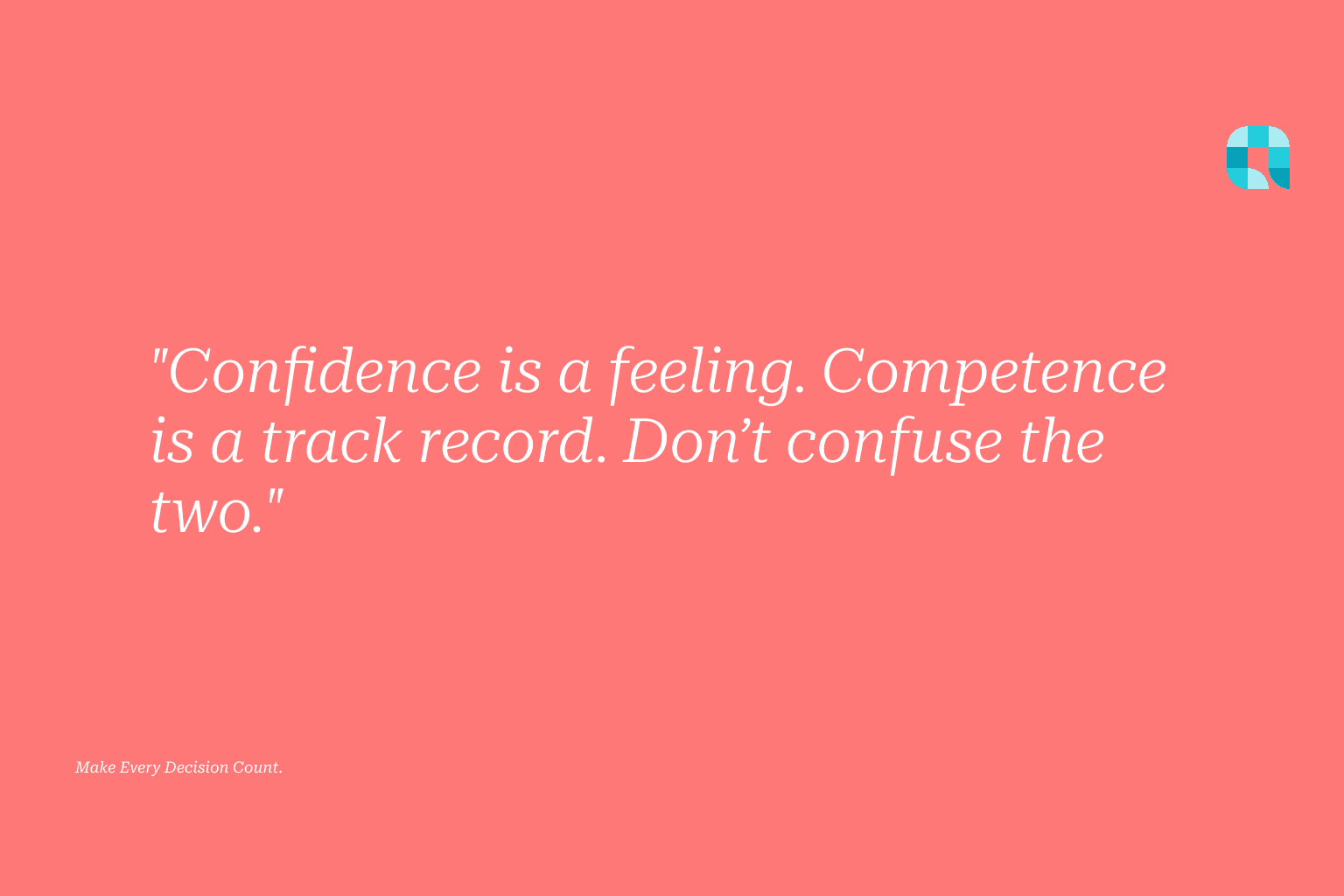
The gap between confidence and competence is where strategies go sideways.
Most leaders are pretty good at recognizing total blind spots. We know when we're completely out of our depth. The problem is the middle ground—where we've got just enough context to feel certain, but not enough to be right.
That's the zone where experience can work against you. You've seen something similar before, so you assume you understand this. You've led through adjacent challenges, so you think the same playbook applies. You've got partial data, so you fill in the gaps with pattern matching.
And sometimes you're right. But when you're wrong, it's expensive.
Here's what changes when you start separating what you know from what you think you know:
→ You slow down on the big calls and ask sharper questions
→ You seek input from people who see what you're missing
→ You test assumptions before betting the budget
→ You build decision frameworks that demand evidence, not just conviction
Better decisions don't come from knowing more. They come from knowing the difference.
The Confidence Trap in SMB Leadership
Most SMB leaders I've worked with are sharp, experienced, and genuinely competent. That's exactly what makes the confidence trap so dangerous.
When you've built something from scratch, or led teams through hard years, you develop pattern recognition that's genuinely valuable. You've earned your instincts. The problem is that those same instincts become a liability when the pattern you're matching is no longer the right one.
The market shifted. The customer changed. The competitive dynamics evolved. But your mental model didn't — and because you've been right before, you didn't think to check.
This shows up everywhere in growing businesses. The founder who knows their customer better than anyone — except the customer has moved on. The executive who's seen this market cycle before — except this time the variables are different. The operator who knows what makes their team tick — except the team is twice the size it was when they learned that.
Confidence built on past success is the most credible-sounding form of ignorance. And it's the hardest to challenge in a room.
How to Build a Decision Practice That Catches Your Blind Spots
The fix isn't to become less confident. It's to build deliberate practices that surface what you're assuming without realizing it.
Here's what I've seen work across businesses of all sizes:
Name your assumptions before you make the call. Before any significant decision, write down the three things that have to be true for this to work. If you can't name them clearly, you haven't thought it through. If you can, you now have something to pressure-test.
Seek out the most credible person who disagrees with you. Not devil's advocates — people who genuinely believe you're wrong and have a reason for it. Their argument will either strengthen your conviction or reveal a gap you hadn't seen.
Run a pre-mortem. Imagine it's 18 months from now and this decision failed badly. What went wrong? This exercise forces your brain out of optimism mode and into diagnostic mode — and it consistently surfaces the assumptions you were glossing over.
Separate the reversible from the irreversible. Most decisions are more reversible than they feel in the moment. For the ones that aren't — the ones you can't easily undo — apply 10x more scrutiny. Those are the calls where blind confidence costs the most.
What This Means for Strategic Decision-Making in Your Business
The companies that scale well aren't the ones with the most decisive leaders. They're the ones with the most honest ones.
Building a culture where assumptions get named and challenged — where "I think" and "I know" mean different things — is a strategic advantage. It means faster course corrections, fewer expensive mistakes, and a leadership team that can adapt rather than double down.
This is increasingly where AI creates real leverage. Not as a decision-maker, but as a thinking partner. When you're willing to surface your assumptions and stress-test them — AI can compress the time it takes to pressure-test scenarios, identify contradictions, and pressure-test your logic before it becomes a costly commitment.
Better decisions don't come from knowing more. They come from knowing what you don't know — and being honest enough to go find out.
Peter Falk is a Fractional CMO and AI Strategy Consultant based in Vancouver, BC. He works with SMB founders and leadership teams across North America to pressure-test business strategy, validate growth assumptions, and build marketing that actually converts.