



The most important part of your model isn't the revenue projection. It's the assumptions that have to be true for everything else to work.
Every business model I've reviewed has one thing in common: a beautiful spreadsheet. Revenue curves up and to the right. Margins improve. Market share grows. The math works.
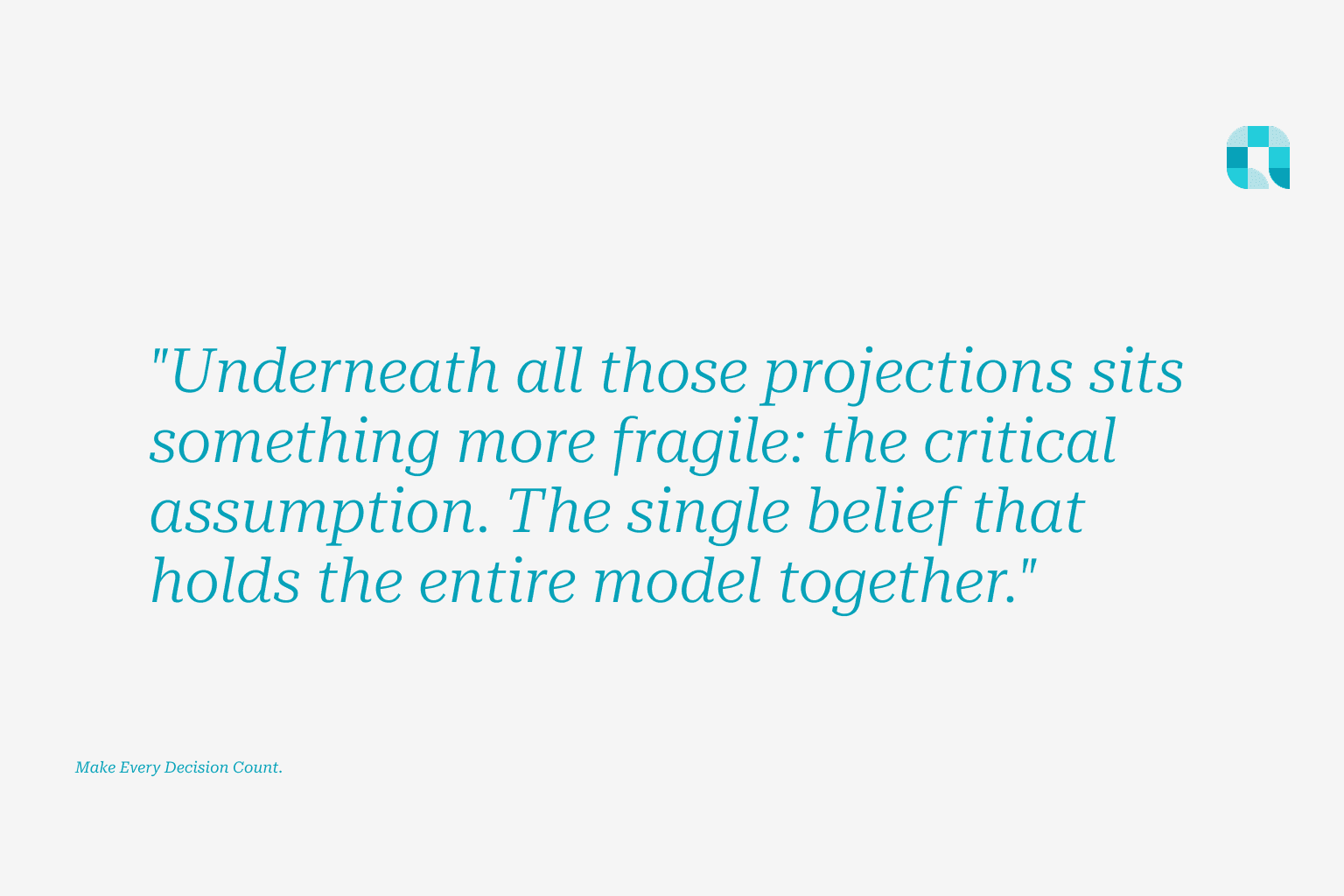
But underneath all those projections sits something more fragile: the critical assumptions. The handful of beliefs that hold the entire model together. If they're wrong, nothing else matters.
I've seen this play out more times than I'd like to admit—both in my own work and with clients. A brand betting on shelf velocity that assumed repeat purchase rates would match trial. A DTC brand projecting profitability that required customer acquisition costs to drop by 40% at scale. A retail expansion built on traffic assumptions that never materialized.
The projections weren't wrong because of bad math. They failed because the foundational assumptions—the things that had to be true—weren't tested rigorously enough.
Here's what I've learned: the critical assumptions aren't always obvious. It's rarely "Will people buy this?" It's more like:
→ Will they buy it again at full price?
→ Will retailers give us the shelf space we're modeling?
→ Will our retention rate hold as we scale into new segments?
→ Can we deliver at this cost structure once promotional pricing ends?
These aren't revenue projections. They're questions about what has to be true for the model to work. And they deserve more scrutiny than your P&L.
So how do you find them?
Work backward from your model. Ask: "If one thing is wrong here, what breaks everything?" Those are your critical assumptions. Then ask: "What's the smallest, fastest, cheapest way to test if these are actually true?"
Maybe it's running a pricing experiment before you scale.
Maybe it's tracking early cohort behavior to validate repeat rates.
Maybe it's testing distribution assumptions in a single market before committing nationally.
The goal isn't to prove you're right. It's to pressure-test the assumptions before you're too committed to pivot.
Because once you've raised capital, hired a team, or locked in distribution—your options narrow. The time to validate your critical assumptions is before the model becomes the plan.
Some other thoughts I had while writing this...
Every model has assumptions that are load-bearing. Find them before someone else does.
Confidence in your projections shouldn't exceed confidence in your assumptions.
If you can't articulate your critical assumptions clearly, you probably haven't identified them yet.
The best founders don't just build models—they build tests to validate what must be true.
#MakeEveryDecisionCount
Peter Falk is a Fractional CMO and AI Strategy Consultant based in Vancouver, BC. He works with SMB founders and leadership teams across North America to pressure-test business strategy, validate growth assumptions, and build marketing that actually converts.