


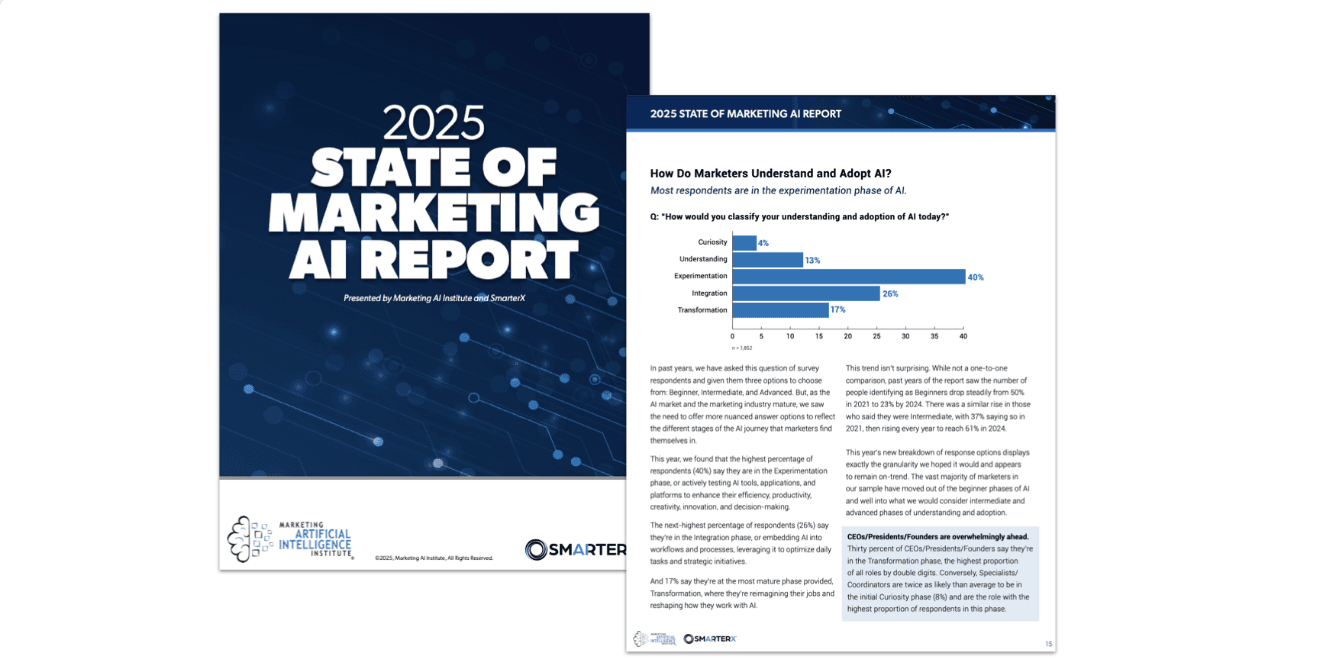
The 2025 State of Marketing AI Report is full of interesting data, but one thing jumps out: most companies aren’t building the foundation needed for sustained competitive advantage from AI. They’re dabbling—getting marginal gains at best—because they haven’t put the pieces in place to execute at scale.
Here’s what the survey says:
62% of companies offer no AI training
75% don’t have a roadmap
67% lack an AI council
63% don’t have a generative AI policy
This isn’t just an operations gap—it’s a leadership failure. You can’t scale what your teams don’t understand. You can’t expect understanding without training. And none of that happens without clear ownership at the top.
Trying to execute without a foundation is what creates fragmented pilots, siloed tools, and unclear ROI. The tech might be new, but the problem isn’t. We’ve seen this same pattern with digital transformation, e-commerce, and data initiatives. Everyone wants the outcome; few are willing to build the capability.
Here’s the fix: build the foundation, then execute. Or—if you’re under pressure—do both in parallel with structured feedback loops. Either way, no shortcuts. The foundation matters if you want to move past experiments and into impact.
AI isn’t going to deliver strategic advantage to companies that treat it like a side project. It’ll reward the ones willing to make it core to how they operate. That starts with leadership, clarity, and investment in capability—not just tools.
[HEADING 2] What "Building the Foundation" Actually Means
Most businesses hear "build the AI foundation" and imagine expensive infrastructure, data science teams, and multi-year transformation programmes. That's not what I'm talking about.
For SMBs and owner-led businesses, the foundation is far more practical — and more achievable than most leaders realize.
It starts with leadership alignment. Someone at the top of the business needs to own AI as a strategic priority. Not as an IT initiative. Not as a cost-saving exercise. As a capability that will determine your competitive position in three years. Without that ownership, everything else becomes a side project.
Then it's training. Not technical training — strategic literacy. Your team doesn't need to know how to build a model. They need to know how to work alongside AI tools, how to evaluate the outputs they're getting, and how to identify where in their workflow AI creates real leverage versus where it creates noise.
Then it's governance — a simple policy that answers the questions your team actually has. What data can we use? What can we share with external tools? What decisions can AI inform, and which require human judgment? You don't need a hundred-page policy. You need clear, practical answers to those four questions.
The Competitive Reality for SMBs Right Now
Here's what the data is actually telling us: most of your competitors haven't built this foundation either.
That's both the problem and the opportunity. The businesses that close the capability gap in the next 12–18 months will be operating at a structural advantage over the ones still treating AI as an experiment. Not because AI is magic — but because the compounding effect of better, faster decisions adds up quickly.
The SMBs I've seen make the most progress aren't the ones with the biggest AI budgets. They're the ones with the clearest priorities. They've identified two or three specific use cases where AI genuinely changes how they operate — and they've built the team capability and process to execute those use cases consistently.
That's it. It doesn't require a transformation programme. It requires leadership clarity and 90 days of focused implementation.
Where to Start: A Practical AI Foundation for SMBs
If you're starting from scratch, here's a realistic 90-day foundation-building plan:
Month 1 — Audit and prioritize. Map your current workflows and identify the five highest-friction, highest-volume tasks in your business. Those are your AI use case candidates. Pick the two with the highest impact-to-effort ratio.
Month 2 — Train and experiment. Get your team working with AI tools on those two use cases. Not in isolation — with structured feedback loops. What's working? What's producing garbage? Where does human judgment still need to be in the loop?
Month 3 — Document and govern. Write down what you've learned. Create a simple policy. Define what good looks like. Make this a repeatable capability, not a one-time experiment.
By month three you'll have more AI competency than 75% of your competitors. And a foundation to build on.
Peter Falk is a Fractional CMO and AI Strategy Consultant based in Vancouver, BC. He works with SMB founders and leadership teams across North America to pressure-test business strategy, validate growth assumptions, and build marketing that actually converts.